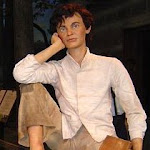
It's been my very real privilege these past few days to be asked by media relations people at a variety of organizations to help them promote their Lincoln Bicentennial events or exhibits. If you're in the New York City area, you won't want to miss an exhibit which begins on Lincoln's birthday at the New York Historical Society.
The companion book to this exhibit features contributions by some of my favorite Lincoln historians, including two who encourage me in my quest to study and promote Lincoln - Harold Holzer and Richard Carwardine.
Here is the information the society asked me to share:
Rare and important Lincoln manuscripts on display
Abraham Lincoln in His Own Words Is Latest Presentation in theLincoln Year, Commemorating the Bicentennial of the Sixteenth President
A draft of the epoch-making “House Divided” speech, stirring notes for an address against slavery, a telegram encouraging General Ulysses S. Grant at a turning point in the Civil War, and the resolution for the Thirteenth Amendment bearing the President’s signature: These are among the rare and important letters, papers and official documents in Abraham Lincoln’s own hand that will be on display, as the New-York Historical Society presents, in partnership with the Gilder Lehrman Institute of American History, the exhibition Abraham Lincoln in His Own Words.
Opening on February 12, 2009 (the 200th anniversary of Lincoln’s birth) and remaining on view through July 12, Abraham Lincoln in His Own Words is the latest offering in the Historical Society’s Lincoln Year of exhibitions, lectures, events and public programs commemorating the bicentennial. The Lincoln Year will culminate in the Historical Society’s major exhibition for 2009, Lincoln and New York (opening October 2), for which the distinguished Lincoln scholar Harold Holzer has served as chief historian.
“Nothing matches the immediacy of approaching a great figure through authentic objects,” stated Dr. Louise Mirrer, President and CEO of the New-York Historical Society. “Visitors to Abraham Lincoln in His Own Words will experience this thrill of physical presence, as they view Abraham Lincoln’s life and career in the original, from his period as an attorney and legislator in Illinois through his assassination and its aftermath.”
“As Lincoln begins his third century in American memory, we hope these documents will help illuminate his unique contribution to our country’s history,” stated James G. Basker, President of the Gilder Lehrman Institute of American History.
In addition to seeing handwritten public documents by Lincoln, visitors will also encounter his more personal side, in letters to a struggling school friend of his eldest son and to his wife Mary (the latter written days before his death). Also on view are first edition texts, including a signed lithograph of his Emancipation Proclamation, a broadside of his Second Inaugural Address distributed in 1865, and a copy of his First Inaugural Address as published in 1861 in the Chicago Tribune.
Lending dramatic context to these items are a variety of other remarkable period objects, such as photographs, prints, sculptures, testimonies, and more. Visitors will see a cast of Lincoln’s face made in 1860 by sculptor Leonard Volk; a photograph by Alexander Gardner of Lincoln and General McClellan in the field in 1862; a Currier & Ives print of the fall of Richmond in 1865; and a letter of condolence to Mary Todd Lincoln from Frederick Douglass, written in August 1865.
Rounding out the exhibition are the original artists’ models by Daniel Chester French for the Lincoln sculpture commissioned by Lincoln, Nebraska (1911) and for the colossal seated figure at the Lincoln Memorial in Washington, D.C. (1916).
With the exception of the sculptures, all objects in the exhibition are drawn from the Gilder Lehrman Collection, which is on deposit at the New-York Historical Society.
An accompanying illustrated book, Great Lincoln Documents: Historians Present Treasures from the Gilder Lehrman Collection, has been published by the Gilder Lehrman Institute of American History, featuring essays by ten noted historians, including James McPherson, Allen Guelzo, David Blight, Richard Carwardine, and Harold Holzer.
Showing posts with label Gilder Lehrman. Show all posts
Showing posts with label Gilder Lehrman. Show all posts
Tuesday, February 10, 2009


Thursday, January 8, 2009
Research isn’t always easy


If I’ve learned nothing else in these past few months, it’s that research isn’t always easy. In fact, maybe it’s never easy – especially when you’re dealing with history and even more so in this electronic age.
History is objective, right?
In my previous scholarly pursuits, the research was easier. I majored in English and specialized in regional and non-fiction literature. As I do with my Lincoln studies, I always consulted a number of sources, but writing about literature can be pretty subjective. Writing about history isn’t, is it? Isn’t history and biography supposed to be objective - cut and dried – crystal clear? This happened or it didn’t. The sources will support it, right? Wrong!
Little did I realize until this fall when I really became a student of Lincoln and the history surrounding him how subjective things in the past can be. As I learned when doing my term paper, myth plays into things, and so do the many different memories people have – often two conflicting mental pictures of the same event. And, in this day and age, when anyone can publish anything on the Internet, there’s a lot of wrong information out there.
The real story of the missions
Early in my recent California visit, my daughter suggested we visit Mission San Juan Capistrano mission. We were barely inside the grounds when she directed me to a plaque which she knew would make my day. It stated that Abraham Lincoln had returned this mission to the Catholic Church in 1865.
Later on our tour, we learned more about Lincoln and the mission at an exhibit inside one of the mission buildings. We even saw a copy of the proclamation Lincoln had signed on March 18, 1865, less than a month before his death.
While at the mission, I bought a very nice book, California Missions and Presidios: The History and Beauty of the Spanish Missions by Randy Leffingwell and Alastair Worden. I’d hoped to consult the book for my blog entry and to share information about each of the missions and the dates Lincoln returned them to the Church.
Unfortunately, even though this volume is written from a more scholarly angle than many of the other books on the mission and is indexed, it still didn’t discuss Lincoln’s involvement with the missions to the extent I’d hoped – nor did it list the dates the proclamations were signed for all of the California missions. I then thought I’d supplement by finding details online. Oh, there were details alright, but often two different sources listed conflicting dates for the return of the same mission.
Opportunity knocks
If this weren’t the bicentennial year and if I didn’t have so much I need to communicate in the coming weeks, I would have taken the time to dig deeper into this subject. Maybe someday I will.
In the meantime, do we have a Lincoln scholar or California history authority out there who can point readers to a good source? Can you tell us – what was Lincoln’s role in this whole mission story? Why did he get involved? What are the specifics and the timeline? I find it interesting that he was dealing with San Juan Capistrano and other missions in the last month of his life with everything else he had going on at the time.
If I’m correct, Lincoln never made it to California. Yet, according to information I found on one of The Gilder Lehrman Institute of American History’s websites, Mr. Lincoln’s White House, on the day he was assassinated Lincoln spoke with Schuyler Colfax of his interest in California and Colfax’s upcoming trip there.
It seems to me we’ve got a topic for further exploration here – Lincoln and California. Has anyone ever studied this subject in depth? If not, it sure does sound like an opportunity for a scholarly paper - or maybe a thesis or dissertation or book. Any takers?
I’ve got my hands full here in Illinois, but the more I study Lincoln, the more topics grab my interest. Oh, if only time and distance were no object!
More than 70 years ago, Lincoln scholar J. G. Randall asked “Has the Lincoln theme been exhausted?” Nearly 30 years ago, Mark E. Neely addressed Randall’s question in an article in the Journal of The Abraham Lincoln Association. Today, more than ever, even with Burlingame’s definitive two-volume biography and scores of other new books coming out in celebration of the bicentennial, opportunity still knocks in the Lincoln world. Fortunately, bright inquisitive minds continue to answer the door, willing to undertake the challenge of research even though it isn't easy.
Subscribe to:
Posts (Atom)


