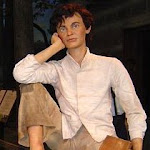
I picked up a book off my nightstand this evening, opened it and found that in researching Edgar Allen Poe for yesterday's article, I’d missed another reference to the writer - one in a Lincoln Prize winning book from a leading Lincoln scholar.
Douglas L. Wilson, of the Lincoln Studies Center at Knox College in my longtime hometown of Galesburg (Ill.), writes of Poe in his book, Lincoln’s Sword: The Presidency and The Power of Words. This Lincoln expert has long been one of my most reliable and helpful "go to" sources for all things Lincoln. I'd consulted one of his books, which didn't have a reference to Poe, but I totally missed this volume. I apologize for the oversight, Dr. Wilson.
Wilson on Poe
As Wilson notes, Lincoln was a prolific writer of newspaper articles, many of them anonymous. In one such article, Wilson writes, Lincoln’s “subject was a strange sequence of events involving the mysterious disappearance of a visitor to Springfield named Fisher.”
Wilson writes that Lincoln’s fascination with the case was:
… firmly centered on the nature of its intellectual challenge, its apparent defiance of rational solution. In this respect, [the article] bears a recognizable resemblance to something one might have read at the time in Edgar Allan Poe, Lincoln’s exact contemporary, and according to one report, his favorite American writer. In fact, Poe’s typically wording and stilted mode of expression may be in part responsible for similar qualities in Lincoln’s essay.
The work Wilson cited as claiming Poe was Lincoln’s favorite writer was an 1860 publication, "The Life of Abraham Lincoln: With Excerpts from His Speeches,” by J.Q. Howard. It seems that many of today’s Lincoln scholars believe now that Walt Whitman was Lincoln’s favorite author of his time.
Wilson’s point is well taken, however, that the influence of Poe’s work can be seen in this particular piece, one that Wilson believes may have been “evidence of a cautious literary debut … protected by a shield of anonymity in the case of failure or indifference.”
The lo’ down on Poe
One thing is certain. Poe’s life, though cut short even sooner than Lincoln’s, ran parallel to the president’s. Lincoln was a prolific reader. As we learned in one of the sources cited in my earlier article on Poe, Lincoln likely owned Poe’s work and is said to have read it. Poe’s work is powerful – and memorable. It can’t help but have left its mark on Lincoln, so mention of Poe in conjunction with the Lincoln Bicentennial is fitting and proper.
Excerpts from:
Wilson, Douglas L., Lincoln’s Sword: The Presidency and the Power of Words, Vintage Books, New York, 2007.
Showing posts with label Edgar Allan Poe. Show all posts
Showing posts with label Edgar Allan Poe. Show all posts
Tuesday, January 20, 2009


Monday, January 19, 2009
Happy 200th, Edgar Allan Poe
Did you know 2009 is not only the bicentennial of Lincoln’s birth, but also of the birth of Edgar Allan Poe and Charles Darwin? Today, January 19, 2009, is the 200th anniversary of Poe’s birth.
I went to several of my favorite Lincoln authors – or their books, actually – to see what they had to say about Lincoln and Poe.
Shenk on Lincoln and Poe
I first consulted Joshua Wolf Shenk’s Lincoln’s Melancholy. I heard Shenk speak twice when he was in Peoria ( Ill.) last summer and I thought I’d remembered him mentioning that Lincoln read Poe. If anyone is an authority on Lincoln’s dark side, this is the guy. And as Shenk points out in his book, “Suffering and futility were pervasive themes in American literature of the early nineteenth century.”
I actually expected to find more references to Lincoln and Poe in Shenk’s work. Though he does refer to Poe and his gloomy work several times throughout the book, there is only one reference to Lincoln reading Poe. I’m finding this lack of much information connecting Lincoln to Poe’s work to be the case throughout my research.
Shenk writes of the early 1940s when Lincoln was serving as a lawyer, riding from town to town on the Eighth Judicial Circuit in Illinois. It was during those evenings away from home, according to the Shenk, that Lincoln’s partner John Todd Stuart remembers Lincoln reading Poe’s “The Raven” over and over by candlelight.
Thomas on Lincoln and Poe
I then went to Benjamin Thomas’s 1953 biography, Abraham Lincoln. Though it’s more than half a century old, this succinct volume is still respected by several leading Lincoln scholars and was even recommended by one of them as the text for a high school class on Lincoln. If Thomas’s account is accurate, it may have been Quincy (Ill.) lawyer Andrew Johnston who first introduced Lincoln to Poe’s work.
According to Thomas, Lincoln had sent some of his own poems to Johnston. Johnston, in turn “sent Lincoln a parody of Poe’s ‘Raven,” in which an experience with a polecat replaced Poe’s conversation with his feathered midnight visitor.” Johnston apparently not only gave Lincoln “several hearty laughs” but also prompted him to seek out Poe’s poem just a year after it was written.
Burlingame on Lincoln and Poe
And finally, I consulted Michael Burlingame, whose two volume biography, Abraham Lincoln: A Life, is the largest work on Lincoln since Sandburg’s six-volume set and will likely reign as the definitive Lincoln biography long into the future.
According to Burlingame, Lincoln liked not only “The Raven,” but “also liked Poe’s short stories, notably ‘The Gold Bug’ and ‘The Facts in the Case of M. Valdemar.”
Special thanks to my Poe-authority
I’d be remiss, however, if I were not to give credit where credit is due for remembering Poe’s birthday so I could share it with you. A few weeks ago, when I told my friend Dr. Robert T. Rhode that I was doing a Lincoln blog, he reminded me that it was also Poe’s bicentennial. Rhode is one of several authorities on the 19th century who has served as a mentor to me. For his nurturing, sharing of knowledge and encouragement, I will always be grateful.
I know Rhode as an authority on steam powers and the owner of a really neat 1923 65-horsepower Case steam engine, which I’ve had the privilege to ride. Yet, he’s also an authority on Poe - teaching his works, writing about him and acting in more than two hundred productions as the poet. In 1988, Rhode performed as Poe for the Baltimore Poe Society, which named his one-person play the authorized stage version of Poe's life.
According to Rhode, the best Poe biography is Arthur Hobson Quinn’s 1941 Edgar Allan Poe: A Critical Biography, which, unfortunately, doesn’t even mention the Lincolns. Rhode cautions those researching Poe to beware of some online sources. He says the authoritative website is that of the Poe Society of Baltimore’s. Thanks, Dr. Rhode, for pointing me to the information showing:
- Lincoln owned an 1845 copy of the booklet that contained “The Raven.”
- A listing of articles by Poe scholar Burton R. Pollin, including one he wrote on polecat parody in the The University of Mississippi Studies in English in 1989 (#100).
After the bicentennial, please watch my blog for more information about Dr. Rhode. Not only is his work on the steam era and Walt Whitman relevant to the study of Lincoln, he’s also the author of some pretty nifty reference books for all students and writers. More on that later …
Excerpts and information taken from:
- Burlingame, Michael, Abraham Lincoln: A Life, Johns Hopkins University Press, Baltimore, 2008.
- Rhode, Robert T., email correspondence, Dec. 2, 2008.
- Shenk, Joshua Wolf, Lincoln’s Melancholy, Houghton Mifflin Company, Boston, 2005.
- Thomas, Benjamin, Abraham Lincoln: A Biography, Alfred A. Knopf, New York, 1953.
Subscribe to:
Posts (Atom)


