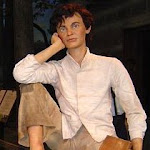
I recently posted a comment in response to another blogger's article about the Lincoln-Douglas Debates. Surprisingly, he asked me for an interview about my interest in Lincoln. The interview is posted today, so here's a link if you want to know more about what drives me to this Lincoln-mania.
The blogger, Ed Newman, who writes Ennyman's Territory, is quite the gifted artist, poet and writer himself. I think this will not be the last you've heard of him, as he, too, may be the subject of one of my blog posts someday.
© Copyright 2009 Ann Tracy Mueller. All rights reserved.
Showing posts with label Lincoln-Douglas Debates. Show all posts
Showing posts with label Lincoln-Douglas Debates. Show all posts
Sunday, May 31, 2009


Sunday, November 2, 2008
A look at some new Lincoln books
As I work today to finish pulling together my paper on Abraham Lincoln and his mentors, I wasn't going to take the time to write a blog post from scratch myself. I was just going to draw attention to an article by Desmond Ryan in today's Philadelphia Inquirer. Ryan's "A. Lincoln turning 200: Books on him keep coming; here's a sampling" provides an overview of nine of the dozens of books on Lincoln coming out within the next year. Of course, as I set out to do that in a few words, I realized I had much to tell you myself about these authors and their books.
An all star cast
I've only got first-hand knowledge of one of these books, but I've met or heard several of the other authors speak at some of the Lincoln scholarly events I've been privileged to attend. These scholars/enthusiasts are Harold Holzer, James McPherson, Gary Ecelbarger, Brian Lamb and Ronald C. White, Jr. Each of these gentlemen is committed to keeping the legacy of Lincoln alive, doing so with accuracy and passion, while earning and keeping the respect of their peers. Any of their books will be a welcome addition to your Lincoln library and a great read, I'm sure.
My lack of familiarity with the other authors in no way negates or diminishes their contributions. It just shows how much work is being done in this area, and how far behind I am in learning all the contributors. Susan Swain, Lamb's co-editor, is also a C-SPAN legend. In her work with the network, she collaborated on The Lincoln-Douglas Debates of 1858 series, American Presidents: Life Portraits, and American Writers II: The 20th Century. I can't wait to read Lamb and Swain's anthology of interviews with Lincoln historians.
Eric Foner's book collecting essays with new perspectives by other brilliant Lincoln scholars will certainly be an interesting read, while Fred Kaplan's study of Lincoln as a writer will focus on what I've always felt was one of Lincoln's greatest gifts and strengths. John Stauffer's book parallels the lives of Lincoln and Frederick Douglass and is sure to shed new perspectives on this important relationship.
Ladies and gentlemen - start your reading
So, head to your library or your local bookstore, or get your Christmas wish list ready. With all these new Lincoln books on the shelves, there's no excuse not to celebrate the Bicentennial of his birth (Feb. 12. 2009) by learning more.
© Copyright 2008 Ann Tracy Mueller. All rights reserved.
An all star cast
I've only got first-hand knowledge of one of these books, but I've met or heard several of the other authors speak at some of the Lincoln scholarly events I've been privileged to attend. These scholars/enthusiasts are Harold Holzer, James McPherson, Gary Ecelbarger, Brian Lamb and Ronald C. White, Jr. Each of these gentlemen is committed to keeping the legacy of Lincoln alive, doing so with accuracy and passion, while earning and keeping the respect of their peers. Any of their books will be a welcome addition to your Lincoln library and a great read, I'm sure.
My lack of familiarity with the other authors in no way negates or diminishes their contributions. It just shows how much work is being done in this area, and how far behind I am in learning all the contributors. Susan Swain, Lamb's co-editor, is also a C-SPAN legend. In her work with the network, she collaborated on The Lincoln-Douglas Debates of 1858 series, American Presidents: Life Portraits, and American Writers II: The 20th Century. I can't wait to read Lamb and Swain's anthology of interviews with Lincoln historians.
Eric Foner's book collecting essays with new perspectives by other brilliant Lincoln scholars will certainly be an interesting read, while Fred Kaplan's study of Lincoln as a writer will focus on what I've always felt was one of Lincoln's greatest gifts and strengths. John Stauffer's book parallels the lives of Lincoln and Frederick Douglass and is sure to shed new perspectives on this important relationship.
Ladies and gentlemen - start your reading
So, head to your library or your local bookstore, or get your Christmas wish list ready. With all these new Lincoln books on the shelves, there's no excuse not to celebrate the Bicentennial of his birth (Feb. 12. 2009) by learning more.
© Copyright 2008 Ann Tracy Mueller. All rights reserved.
Friday, October 31, 2008
Boy, has research changed!
It's been 14 years since I graduated from college, and 38 since I started the first time. No, I didn't go to school for 24 years straight. I took some time off after my first two years - and appreciated the experience much more the second time around.
Now, I'm back in the classroom again, and it still feels right. What amazes me the most this time, though, is how technology has changed the whole research experience in just these few short years since I was last in school.
Google, Noodle, J-Stor. If you'd have thrown these names at me a few years ago and told me I'd be singing their praises today, I'm sure I would have looked at you with furled brow and questioning eyes. Tonight, as I pull my paper together, I don't know what I did without these and the other electronic tools which make research so much easier and sources so much more accessible.
Searching funky things
Google is my search engine of choice, and thanks to a tip through a YouTube clip on Samuel P. Wheeler's website, Google Books is becoming my best friend. To think that there are books you can search right from the comfort of your computer at midnight or 5:00 a.m. just blows me away.
Noodle is this neat tool which creates your citations for you. I'm still learning it, but a little cutting and pasting into a template, and all the formatting is done for me - indents and all. No longer will I need that little blue term paper guide I've been using since the nuns introduced me to it back when I started high school in 1966 - nor will I have to fight with the tab key on my keyboard.
For years, when I walked into the Galesburg Public Library, just a couple blocks from the site of the 1858 Lincoln-Douglas Debate or Seymour Library on the Knox College campus just a couple buildings from Old Main, I headed straight to the Reader's Guide to Periodicals or the card file. Now, I can find all the articles I need online through J-Stor and borrow books from other libraries through I-Share. Everything is so much more accessible today, thanks to these tools I'm privileged to use as a Heartland College student.
I even found newspapers articles about Lincoln through Wheeler's site. It's all so incredible!
Pluses and minuses
The pluses - you can find everything you're looking for and so much more.
The minuses - you can find everything you're looking for and so much more.
That's right, once you get started on a research project, you can really go to town. In the past, you'd scrounge to find a few sources accessible through the libraries nearby, call it quits and do the paper with what you could find. Now it's all at your fingertips.
But, once you get started on a research project, you don't know where to stop. There is so much available, and there are so many different points of view. There is so much myth and so much scholarship and it's so addictive.
You know some of the paths you've stumbled on today will be paths you'll have to leave untrodden today, but your heart tells you you'll be back. The bug of scholarship has bitten. You'll do this paper, within the scope you set for yourself, but you'll return. You'll seek out those other trails, you'll cut the brush aside just like those early settlers to Illinois and you'll move forward on that next Lincoln project, knowing it, too, will just lead to one more. Now I know why those Lincoln scholars I admire do what they do. They can't help it either!
© Copyright 2008 Ann Tracy Mueller. All rights reserved.
Now, I'm back in the classroom again, and it still feels right. What amazes me the most this time, though, is how technology has changed the whole research experience in just these few short years since I was last in school.
Google, Noodle, J-Stor. If you'd have thrown these names at me a few years ago and told me I'd be singing their praises today, I'm sure I would have looked at you with furled brow and questioning eyes. Tonight, as I pull my paper together, I don't know what I did without these and the other electronic tools which make research so much easier and sources so much more accessible.
Searching funky things
Google is my search engine of choice, and thanks to a tip through a YouTube clip on Samuel P. Wheeler's website, Google Books is becoming my best friend. To think that there are books you can search right from the comfort of your computer at midnight or 5:00 a.m. just blows me away.
Noodle is this neat tool which creates your citations for you. I'm still learning it, but a little cutting and pasting into a template, and all the formatting is done for me - indents and all. No longer will I need that little blue term paper guide I've been using since the nuns introduced me to it back when I started high school in 1966 - nor will I have to fight with the tab key on my keyboard.
For years, when I walked into the Galesburg Public Library, just a couple blocks from the site of the 1858 Lincoln-Douglas Debate or Seymour Library on the Knox College campus just a couple buildings from Old Main, I headed straight to the Reader's Guide to Periodicals or the card file. Now, I can find all the articles I need online through J-Stor and borrow books from other libraries through I-Share. Everything is so much more accessible today, thanks to these tools I'm privileged to use as a Heartland College student.
I even found newspapers articles about Lincoln through Wheeler's site. It's all so incredible!
Pluses and minuses
The pluses - you can find everything you're looking for and so much more.
The minuses - you can find everything you're looking for and so much more.
That's right, once you get started on a research project, you can really go to town. In the past, you'd scrounge to find a few sources accessible through the libraries nearby, call it quits and do the paper with what you could find. Now it's all at your fingertips.
But, once you get started on a research project, you don't know where to stop. There is so much available, and there are so many different points of view. There is so much myth and so much scholarship and it's so addictive.
You know some of the paths you've stumbled on today will be paths you'll have to leave untrodden today, but your heart tells you you'll be back. The bug of scholarship has bitten. You'll do this paper, within the scope you set for yourself, but you'll return. You'll seek out those other trails, you'll cut the brush aside just like those early settlers to Illinois and you'll move forward on that next Lincoln project, knowing it, too, will just lead to one more. Now I know why those Lincoln scholars I admire do what they do. They can't help it either!
© Copyright 2008 Ann Tracy Mueller. All rights reserved.
Subscribe to:
Posts (Atom)


